Showing posts with label smarthome. Show all posts

Wednesday, April 20, 2016

AC Ducts in Conditioned Space : Being Smart & Cost-Effective


Designing and locating the HVAC ducts (and the air handling unit (AHU)) within the home's conditioned space can minimize energy losses significantly by increasing the operating efficiency of the HVAC system in your home.. As per studies by US Department of Energy (DOE) and EPA, moving ducts within the conditioned space can reduce cooling and heating loads by over 10%.
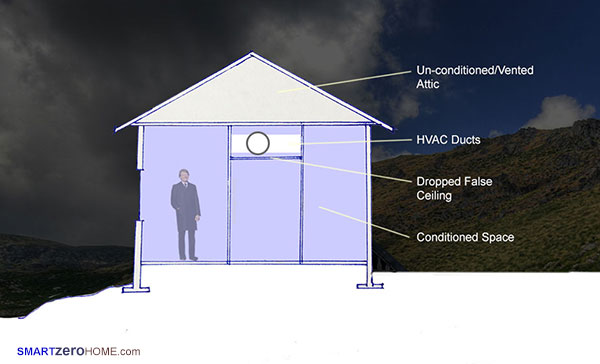
Even if ducts are well insulated there could be leakages at some points (damaged/ decaying insulation (over time)), causing loss of conditioned air, or if the ducts are located in vented attics or crawl spaces there could be energy losses because of temperature difference (delta).
1) Insulating the attic (if ducts in attic) or 2) using a false/dropped ceiling in your home corridors (where the ducts are running) are two most effective and economical solutions 
One of the best ways to accommodate ducts in conditioned space (also possible in case of late design stage intervention and retrofitting) is using dropped false ceiling - one can drop the ceiling within the circulation space (ducts run in the circulation space) to accommodate the ducts within the conditioned space. The AHU can be located in the closet and the supply registers to individual rooms can be on the wall surface adjoining the corridor, thus maintaining the height of individual rooms.
There are other ways of locating ducts in conditioned space, such as insulating the attic and laying the ducts in the attic. This will be cheaper to implement but will be more expensive, requiring larger HVAC and resulting in higher energy bills, as the entire attic becomes part of the conditioned space (increasing the volume that needs to be conditioned by the HVAC system). 

Saturday, April 16, 2016

Phantom Loads in Your Home & How to Control Them...

Plug Loads or electricity usage from devices and appliances that are plugged into electric sockets can account for electricity usage even when not in use or even when they are turned off. This energy usage by plugged-in appliances is often referred to as “phantom loads”. These can account for over $100 of energy bills over a year in a typical 3 bedroom home.

There are a number of advanced power strips and controls that are available to counter these phantom plug loads. These power strips and controls can be plugged into the electric socket, and the appliances in turn can be plugged into the power strip. These strips can be driven by an occupancy sensor (senses the absence and turns-off), or a timer (based on pre-set schedule (e.g. post 10pm)), or remotely controlled, or just be a simple master strip that can be turned off manually. Controls from companies such as WeMo and TP Link can be accessed from your mobile phones and are Wi-Fi enabled.
Plug load controls can reduce the 'Phantom Loads' by ensuring the appliances are switched off
Here are the best plug load controls available in the market today, based on our analysis, and feedback from customers and contractors:
- See more at: http://www.smartzerohome.com/Smart_PhantomLoadControls.html#sthash.kfKUpPuU.dpuf


http://www.smartzerohome.com/Smart_PhantomLoadControls.html

Sunday, April 10, 2016

Top 5 Light Dimmers in the Market

Light Dimmers are used to decrease the lighting consumption by 65% (for CEC certification) and more, and are effective in areas where the light usage varies based on time of day and need.
Hallways and other common areas, bedrooms, dining room and family room are ideal spaces for light dimmer installation. Dimmers can be used with track lighting and recessed can lights.
Light Dimmers are ideal for spaces where the light use varies based on time of day and your needs
Here are the top 5 light occupancy dimmers available in the market today, based on our analysis, and feedback from customers and retailers (full table at this link: http://www.smartzerohome.com/Lights_top5LightDimmers.html):
CompanyLutronLevitonEnerlitesHoneywellWattstopper
Rating*98.299.48
Price**$45.5$17.2$12.0$32.4$9.9


- See more at: http://www.smartzerohome.com/Lights_top5LightDimmers.html#sthash.1TD1epZn.dpuf

Thursday, March 31, 2016

What is a Smart Home?


The definition of a “Smart Home” has continued to evolve with newer technological advancements. A Smart Home maximizes the comfort of the resident, in the most cost-effective way. We (smartzerohome.com) would extend the definition of a Smart Home to include it being a solar powered energy efficient self-sufficient net Zero Energy home.
Various smart devices can be connected – monitored and controlled – under one platform
A Smart Home consists of smart connected devices and appliances that act based on the home resident’s desires and behaviors, to maximize their comfort. A Smart Home accomplishes this objective through connected devices and smart appliances that are connected via a Connected Smart Home Platform and/or a Home Energy Management System which allows them to communicate with each other and follow a pre-selected course of action based on the home resident’s behavior, and on the most cost-effective energy efficiency strategy.

See more at SmartZeroHome.comwww.smartzerohome.com