Showing posts with label architecture. Show all posts

Wednesday, April 20, 2016

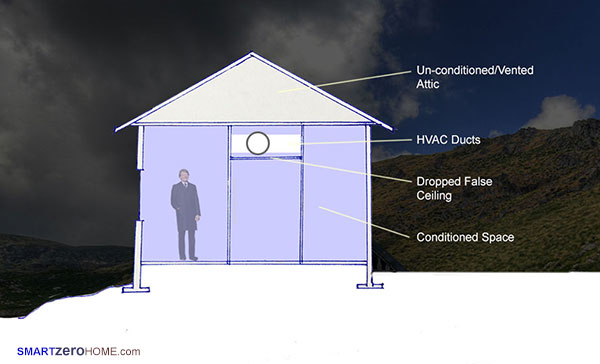
AC Ducts in Conditioned Space : Being Smart & Cost-Effective


Designing and locating the HVAC ducts (and the air handling unit (AHU)) within the home's conditioned space can minimize energy losses significantly by increasing the operating efficiency of the HVAC system in your home.. As per studies by US Department of Energy (DOE) and EPA, moving ducts within the conditioned space can reduce cooling and heating loads by over 10%.
Even if ducts are well insulated there could be leakages at some points (damaged/ decaying insulation (over time)), causing loss of conditioned air, or if the ducts are located in vented attics or crawl spaces there could be energy losses because of temperature difference (delta).
1) Insulating the attic (if ducts in attic) or 2) using a false/dropped ceiling in your home corridors (where the ducts are running) are two most effective and economical solutions 
One of the best ways to accommodate ducts in conditioned space (also possible in case of late design stage intervention and retrofitting) is using dropped false ceiling - one can drop the ceiling within the circulation space (ducts run in the circulation space) to accommodate the ducts within the conditioned space. The AHU can be located in the closet and the supply registers to individual rooms can be on the wall surface adjoining the corridor, thus maintaining the height of individual rooms.
There are other ways of locating ducts in conditioned space, such as insulating the attic and laying the ducts in the attic. This will be cheaper to implement but will be more expensive, requiring larger HVAC and resulting in higher energy bills, as the entire attic becomes part of the conditioned space (increasing the volume that needs to be conditioned by the HVAC system). 

Sunday, April 10, 2016

Light Design 101


http://www.smartzerohome.com/LightDesign101.html

Lighting alone can account for a significant energy use in your home (see our design tool to know how important lighting is in your home) and is the highest energy guzzler in an office building. Deploying advanced lighting controls coupled with high efficiency lighting fixtures can result in lighting energy savings of over 30%.
Efficient lighting design strategies :
1) High Efficiency Lights: Replace existing incandescent bulbs with the more efficient LED lamps and CFL lamps. LEDs are more efficient options, and are available in a number of colors and fixture options. To learn more click here. 
2) Optimum Light Design: High illumination levels (high light intensity or bright light) can be discomforting and damaging to the eyes and also consume unnecessary electricity. Buy the right intensity light fixtures, and use dimmers for spaces with varying light needs. Dimmers ensure that there is an appropriate illumination levels befitting the time, need and occasion. See our post on advanced light controls.
High illumination levels can be discomforting and damaging to the eyes
3) Use lights only when needed: Occupancy Sensors ensure that lights are switched off when the space is not being used, and the lights are switched off even if someone forgot to switch them off when leaving the space/room. See our pick of the best occupancy light sensors in the market today.
4) Daylighting: Natural light should be used whenever and wherever possible. It is also a healthier option. You can use window shades to cut off the direct sun, while still getting the diffused light for lighting the space. North facing windows do not get direct sun, and are ideal for daylighting. Intelligent daylighting can also be used as a source for passive solar heating. See our post on daylighting.

Check out our pick of top 5 LED lights, and top 5 light sensors.
- See more at: http://www.smartzerohome.com/LightDesign101.html#sthash.6l6aj6ud.dpuf